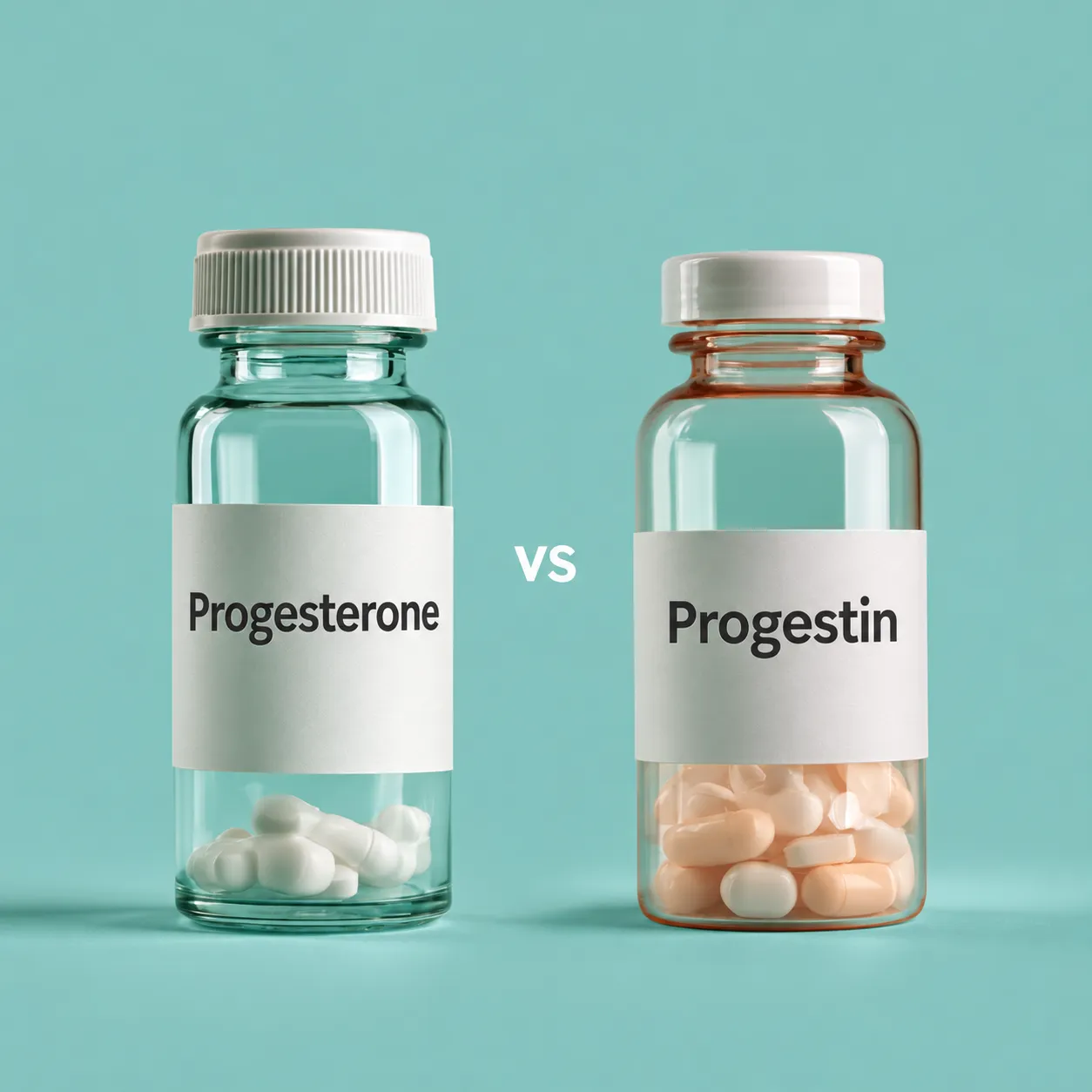
First, Let's Talk About Progesterone
If you have ovaries, progesterone has been running quietly in the background of your life since your cycles settled in after puberty. It's made mainly after ovulation, rises and falls with your monthly cycle, surges during pregnancy, and then — somewhere in your 40s — starts to quietly ghost you. In perimenopause, ovulation becomes less reliable, so progesterone is often one of the first hormones to decline, while estrogen can actually run high and unpredictable before it falls.1,2
But here's something most of us were never taught: progesterone does a LOT more than just support a pregnancy or thicken your uterine lining. It's a full-body hormone with effects on your brain, your bones, your heart, your sleep, and your mood.
Here's a quick snapshot of what real, natural progesterone actually does — and how strong the evidence is for each:
- Brain & mood: Your body turns some progesterone into a compound called allopregnanolone, which acts on GABA receptors in the brain — the same family of "calming" receptors that some anti-anxiety and sleep medicines target, though at a different spot. That's why progesterone can make you drowsy, and why it's usually taken at bedtime.3,23
- Sleep: Many women report sleeping better on bioidentical progesterone, and small clinical trials back this up: bedtime micronized progesterone helped women fall asleep faster and wake less during the night.3,18,19,20
- Bones: Dr. Jerilynn C. Prior of the Centre for Menstrual Cycle and Ovulation Research has proposed that progesterone helps build bone alongside estrogen. Her 2017 analysis found that adding a progestin to estrogen gave a small extra boost to spine bone density — but in those trials, the progestin was the synthetic MPA. Whether natural progesterone on its own protects bone hasn't yet been proven in large trials.4,5
- Heart & blood vessels: Early studies are reassuring. In a small lab study, progesterone didn't harm blood vessel function, and its effect was similar to estradiol's. A 3-month trial found no change in blood pressure, weight, or blood vessel function compared with a placebo. What we don't have yet is evidence that progesterone actively protects the heart.6,7
- Uterine protection: When you're taking estrogen therapy and still have a uterus, a progestogen is essential for protecting the uterine lining from overgrowth that can lead to endometrial cancer. In a 3-year randomized trial, cyclic micronized progesterone protected the lining as well as the synthetic options did.8
- Breast tissue: In lab studies, progesterone can temper estrogen's growth signals in breast cells. In real-world studies of women, estrogen plus bioidentical progesterone looks neutral or lower-risk for the breast compared with synthetic progestins, especially for up to about five years of use. That isn't the same as being protective.9,10,16
So What Is a Progestin, and Why Does It Even Exist?
Here's where things get interesting — and a little bit infuriating.
Back in the 1940s and 50s, researchers wanted to put progesterone into a pill. The problem? Natural progesterone was rapidly broken down by the liver when swallowed, so it couldn't be reliably absorbed as an oral medication. And as a molecule your body already makes, progesterone itself couldn't be patented as a new drug.
So pharmaceutical companies did what pharmaceutical companies do: they tweaked the molecule. By making chemical changes to progesterone's structure — adding groups here, shifting bonds there — they created entirely new synthetic compounds that could:
- Survive the liver: so they could be taken as a pill
- Be patented: and therefore turned into profitable brand-name drugs
- Act on progesterone receptors: mimicking some (but not all) of progesterone's actions
The first oral progestin, norethindrone, was created in 1951. The most famous, medroxyprogesterone acetate (MPA), was approved as Provera in 1959 and became the go-to progestin in hormone replacement therapy for decades. Depo-Provera (the birth control shot) is also MPA. An oral form of natural progesterone didn't arrive until a newer "micronized" formulation made it absorbable — the FDA approved it as Prometrium in 1998. If you've been on HRT for perimenopause or menopause, there's a good chance you've been prescribed a synthetic progestin — possibly without being fully told the distinction.
Other common progestins you'll hear about include norethindrone, levonorgestrel (the Mirena IUD and many birth control pills), and drospirenone (Yaz, Yasmin). These are not the same molecule as progesterone. They're synthetic drugs that bind to progesterone receptors — but depending on the type, they can also act on other hormone receptors, which is where some of the problems begin.11
The Critical Difference: Same Job, Very Different Résumé
Think of it this way: both progesterone and progestins can show up for the same job — protecting the uterine lining when you're on estrogen therapy. But once they're on the job, they behave very differently throughout the rest of the building.
Natural, Bioidentical Progesterone
- Molecularly identical to the hormone your ovaries actually make
- Converts partly into allopregnanolone, a calming brain compound — which is why it's taken at bedtime and may help sleep
- Appears to carry less breast cancer risk than synthetic progestins in observational studies, especially with shorter use
- Kinder to "good" HDL cholesterol than MPA in a large randomized trial
- Neutral for blood vessels in small short-term studies
- Lower blood clot risk than some synthetic versions in observational studies
Synthetic Progestins
- Chemically modified — share some actions with progesterone but are structurally different
- May also act on androgen, glucocorticoid (stress-hormone), or other receptors, depending on the type — each progestin has its own profile
- Most, including MPA, don't work like allopregnanolone — so they don't offer progesterone's sleepy, calming effect
- Linked in research to increased breast cancer risk, especially combined with estrogen over multiple years
- May blunt estrogen's cholesterol benefits depending on the specific progestin
- Can carry a higher VTE risk (blood clots in veins), especially oral types combined with oral estrogen
What the Research Actually Says
For years, progesterone and progestins were used interchangeably in medical literature and clinical practice — lumped together under the umbrella term "progestogens." That grouping has caused enormous confusion and may have led to worse health outcomes for a lot of women.
Here's what researchers have found when they've actually looked at the two side by side:
- Breast cancer risk: A 2016 review that pooled three large observational studies (nearly 87,000 women) found that women using estrogen with bioidentical progesterone had about a one-third lower breast cancer risk than women using estrogen with a synthetic progestin. These studies show an association, not proof, and the reassurance is strongest for up to about five years of use.9,10
- Blood clot risk (VTE): A 2023 study of more than 36,000 US women's insurance records found fewer blood clots in women taking oral estradiol with bioidentical progesterone than in those taking Premarin-type estrogen with MPA — about 37 versus 53 clots per 10,000 women each year. The study was funded by the maker of the estradiol-progesterone pill, and it changed both the estrogen and the progestogen, so progesterone can't take all the credit. Other research suggests that estrogen through the skin (patch or gel) carries the lowest clot risk of all.12,13,14
- Cholesterol and heart health: In the PEPI trial — a 3-year randomized trial of 875 postmenopausal women — estrogen plus micronized progesterone raised HDL ("good") cholesterol more than estrogen plus MPA (about 4 versus 1–2 mg/dL). Side effects such as breast tenderness were similar across the progestogen regimens.15,24
- Breast cell growth: Lab research published in Nature (2015) found that when the progesterone receptor is switched on — by natural progesterone or a synthetic progestin — it can redirect estrogen's activity and slow the growth of estrogen-sensitive breast cancer cells. This was done in cancer cells and mice, not in women taking hormone therapy, so it helps explain the biology but doesn't prove progesterone protects the breast.16
- Bone health: The bone trials so far mostly used the synthetic progestin MPA, which added a small boost to estrogen's effect on spine bone density. Natural progesterone may support bone-building cells, but that hasn't been confirmed in large trials yet.4,5
Compared with women who never used HRT, estrogen plus a synthetic progestin was linked to a 69% higher relative risk of breast cancer. Estrogen plus bioidentical progesterone showed no overall increase — though in that group, risk crept up with longer use (beyond about four to five years).17
It's worth noting: much of the research in this space is observational rather than large-scale randomized controlled trials using bioidentical progesterone specifically. The science is real and building, but researchers consistently call for more head-to-head studies. The takeaway is not "progesterone is perfect and progestins are poison" — it's "these are meaningfully different compounds, and the difference matters."
The WHI Study: The One That Scared Everyone
If you've ever tried to talk to a doctor about hormone therapy and been met with hesitation — or a flat-out no — the Women's Health Initiative (WHI) study from the early 2000s is probably why.
In this large clinical trial, more than 16,000 women aged 50 to 79 took either a placebo or combined hormone therapy: conjugated equine estrogen (Premarin — derived from pregnant mares' urine) plus medroxyprogesterone acetate (Provera), a synthetic progestin, in one daily pill. After about five years, that arm of the trial was stopped early. For every 10,000 women per year, there were about 8 more breast cancers, 8 more strokes, 8 more blood clots in the lungs, and 7 more heart events — but also 6 fewer colorectal cancers and 5 fewer hip fractures.21 The headlines were terrifying. And millions of women quit hormone therapy — within a year, Prempro prescriptions had dropped by about two-thirds.22
- The progestin used was MPA — a synthetic progestin that, unlike progesterone, also acts on cortisol-type and androgen receptors. The two were never directly compared.11
- The estrogen used was Premarin, a conjugated equine estrogen taken orally — not the transdermal patch or gel increasingly used today.
- The women enrolled were older — average age at enrollment was 63, more than a decade past the typical age of menopause.
- Bioidentical progesterone was not studied. The WHI told us about synthetic progestins combined with oral conjugated estrogen in older women — not natural progesterone.
To be fair, the WHI tested the most popular regimen of its day — Premarin and Prempro made up most US prescriptions at the time.22 But it didn't test the options many clinicians prefer today, like estradiol patches or gels and bioidentical progesterone, and it didn't focus on women starting treatment near menopause. The lasting damage came from applying its results to every type of hormone therapy, conflating "progestins" with "progesterone" in the public conversation — and leaving an entire generation of women under-treated for menopausal symptoms.
Sleep, Mood, and the Brain: Where Progestins Fall Flat
One of the most meaningful differences between natural progesterone and synthetic progestins is what happens in your brain — and this is an area where women are getting shortchanged when they're prescribed a progestin instead of bioidentical progesterone.
Natural progesterone is converted in the brain and nervous system into a compound called allopregnanolone. Allopregnanolone acts on GABA receptors — the same receptor family targeted by anti-anxiety drugs and sleep medications. It has a genuine, physiological calming, sleep-promoting effect. Most synthetic progestins, including MPA, don't work this way, so you don't get that neurological benefit.3,23
Falling asleep faster and staying asleep through the night. Reduced nighttime anxiety and that "wired but tired" feeling easing up. A more balanced mood, particularly for women prone to progesterone-related mood dips — when taking bioidentical progesterone orally at night. In small clinical trials, bedtime progesterone helped women fall asleep faster and wake less during the night, and The Menopause Society notes that 300 mg nightly improves sleep and reduces night sweats.3,18,19,20,25
That said — it's not a universal experience. Some women find progesterone makes them feel foggy, low, or moody; some clinicians say a minority of their patients describe it as "PMS in a bottle." Bodies are genuinely different, so tell your clinician if that happens to you. But for many women — especially those struggling with perimenopausal sleep disruption — bioidentical progesterone taken at bedtime is a game-changer that a synthetic progestin simply cannot replicate.
What About Birth Control?
Almost all hormonal birth control — pills, patches, the hormonal IUD, the shot, the implant — uses synthetic progestins, not bioidentical progesterone. This is because progestins are more potent, more predictable, and can be reliably dosed as synthetic drugs.
Some progestins used in birth control, such as levonorgestrel, are more androgenic — meaning they also act on testosterone receptors — which can contribute to acne or unwanted hair growth in some women. Newer progestins (like drospirenone) were designed to be anti-androgenic to counter this.11
- They are effective at preventing pregnancy through multiple mechanisms — suppressing ovulation, thickening cervical mucus, and thinning the uterine lining
- They don't provide the sleep and mood benefits of natural progesterone
- Progestin-only options (like the mini-pill or hormonal IUD) are often recommended for women who can't take estrogen
- The Mirena IUD uses levonorgestrel locally in the uterus — absorption into the bloodstream is low, lower than with the pill, though some women still notice side effects such as acne or mood changes
For women in perimenopause who are still needing contraception and also dealing with symptoms, this gets complicated — because birth control pills contain progestins, not progesterone, and the two serve very different purposes in the body.
Bioidentical Progesterone: What's Actually Available
If you're interested in exploring natural, bioidentical progesterone rather than a synthetic progestin, here's what's out there — only the first two are FDA-approved:
One important note: "bioidentical" has become a marketing term that doesn't always mean what it sounds like. Some compounded hormone therapies are marketed as "bioidentical" simply because they contain naturally-derived ingredients — but without standardized testing and dosing. The Menopause Society, the American College of Obstetricians and Gynecologists, and the National Academies all recommend FDA-approved options first, such as oral micronized progesterone (Prometrium or its generics). Compounded hormones are a backup for special situations — like an allergy to an ingredient in the approved product — prescribed by a clinician who specializes in hormone therapy.25,28,29
So What Does All This Mean for You?
Here's the practical takeaway, spelled out plainly:
- Not all progesterone-like hormones are created equal.
Natural, bioidentical progesterone and synthetic progestins are different compounds with different effects on your body, brain, and long-term health.
- The landmark study that scared everyone off HRT tested synthetic progestins — not bioidentical progesterone.
The blanket fear that developed was not fully warranted for natural progesterone.
- If you have a uterus and take estrogen, you need something to protect your uterine lining.
That something can be either a progestin or bioidentical progesterone — and the evidence, mostly from observational studies, increasingly suggests the latter carries a better risk profile.
- If sleep and mood are significant concerns,
bioidentical progesterone (taken orally at night) may help with sleep in ways synthetic progestins don't.
- Your medical vocabulary matters.
Many healthcare providers use "progesterone" and "progestin" interchangeably. They are not the same thing. It's worth asking specifically: "Is this bioidentical progesterone, or a synthetic progestin?"
- Individual response varies.
Some women thrive on progestins. Some do better on bioidentical progesterone. Some have health histories that make one a better fit than the other. This isn't a one-size-fits-all conversation.
- Not all progestins are MPA.
In large European studies, bioidentical progesterone and the progestin dydrogesterone (not sold in the US) have been linked to lower breast cancer risk than older synthetic progestins such as MPA and norethindrone — though risk still rose with longer use for most combinations. The conversation is nuanced.17,30,31
The most important thing you can do is walk into your next appointment informed. Know the difference. Ask the question. You deserve a provider who can explain the distinction clearly — and who will tailor a plan to your actual history, your actual symptoms, and your actual body.
Understanding the difference between natural progesterone and synthetic progestins isn't just a biochemistry lesson — it's one of the most important conversations women can have about their own hormonal health. The research is real, it's building, and it belongs in your hands.
— Verbose Publications
Sources & Research
Numbered sources are cited in the text above. Where it matters, the text notes whether findings come from randomized trials, observational studies, or lab research, and whether a figure is relative or absolute. Sources checked November 2026.
- Santoro N, Brown JR, Adel T, Skurnick JH. Characterization of reproductive hormonal dynamics in the perimenopause. J Clin Endocrinol Metab. 1996;81(4):1495-1501. PubMed 8636357
- Prior JC. Perimenopause: the complex endocrinology of the menopausal transition. Endocr Rev. 1998;19(4):397-428. PubMed 9715373
- Nolan BJ, Liang B, Cheung AS. Efficacy of micronized progesterone for sleep: a systematic review and meta-analysis of randomized controlled trial data. J Clin Endocrinol Metab. 2021;106(4):942-951. PubMed 33245776
- Prior JC, Seifert-Klauss VR, Giustini D, Adachi JD, Kalyan S, Goshtasebi A. Estrogen-progestin therapy causes a greater increase in spinal bone mineral density than estrogen therapy: a systematic review and meta-analysis of controlled trials with direct randomization. J Musculoskelet Neuronal Interact. 2017;17(3):146-154. PubMed 28860416
- Prior JC. Progesterone for the prevention and treatment of osteoporosis in women. Climacteric. 2018;21(4):366-374. PubMed 29962257
- Mather KJ, Norman EG, Prior JC, Elliott TG. Preserved forearm endothelial responses with acute exposure to progesterone: a randomized cross-over trial of 17-beta estradiol, progesterone, and 17-beta estradiol with progesterone in healthy menopausal women. J Clin Endocrinol Metab. 2000;85(12):4644-4649. PubMed 11134122
- Prior JC, Elliott TG, Norman E, Stajic V, Hitchcock CL. Progesterone therapy, endothelial function and cardiovascular risk factors: a 3-month randomized, placebo-controlled trial in healthy early postmenopausal women. PLoS One. 2014;9(1):e84698. PubMed 24465425
- The Writing Group for the PEPI Trial. Effects of hormone replacement therapy on endometrial histology in postmenopausal women: the Postmenopausal Estrogen/Progestin Interventions (PEPI) Trial. JAMA. 1996;275(5):370-375. PubMed 8569016
- Asi N, Mohammed K, Haydour Q, et al. Progesterone vs. synthetic progestins and the risk of breast cancer: a systematic review and meta-analysis. Syst Rev. 2016;5(1):121. PubMed 27456847
- Stute P, Wildt L, Neulen J. The impact of micronized progesterone on breast cancer risk: a systematic review. Climacteric. 2018;21(2):111-122. PubMed 29384406
- Stanczyk FZ, Hapgood JP, Winer S, Mishell DR Jr. Progestogens used in postmenopausal hormone therapy: differences in their pharmacological properties, intracellular actions, and clinical effects. Endocr Rev. 2013;34(2):171-208. PubMed 23238854
- Panay N, Nappi RE, Stute P, et al. Oral estradiol/micronized progesterone may be associated with lower risk of venous thromboembolism compared with conjugated equine estrogens/medroxyprogesterone acetate in real-world practice. Maturitas. 2023;172:23-31. (Funded by Theramex.) PubMed 37084589
- Canonico M, Oger E, Plu-Bureau G, et al. Hormone therapy and venous thromboembolism among postmenopausal women: impact of the route of estrogen administration and progestogens: the ESTHER study. Circulation. 2007;115(7):840-845. PubMed 17309934
- Vinogradova Y, Coupland C, Hippisley-Cox J. Use of hormone replacement therapy and risk of venous thromboembolism: nested case-control studies using the QResearch and CPRD databases. BMJ. 2019;364:k4810. PubMed 30626577
- The Writing Group for the PEPI Trial. Effects of estrogen or estrogen/progestin regimens on heart disease risk factors in postmenopausal women: the Postmenopausal Estrogen/Progestin Interventions (PEPI) Trial. JAMA. 1995;273(3):199-208. PubMed 7807658
- Mohammed H, Russell IA, Stark R, et al. Progesterone receptor modulates ERα action in breast cancer. Nature. 2015;523(7560):313-317. PubMed 26153859
- Fournier A, Berrino F, Clavel-Chapelon F. Unequal risks for breast cancer associated with different hormone replacement therapies: results from the E3N cohort study. Breast Cancer Res Treat. 2008;107(1):103-111. PubMed 17333341
- Montplaisir J, Lorrain J, Denesle R, Petit D. Sleep in menopause: differential effects of two forms of hormone replacement therapy. Menopause. 2001;8(1):10-16. PubMed 11201509
- Schüssler P, Kluge M, Yassouridis A, et al. Progesterone reduces wakefulness in sleep EEG and has no effect on cognition in healthy postmenopausal women. Psychoneuroendocrinology. 2008;33(8):1124-1131. PubMed 18676087
- Caufriez A, Leproult R, L'Hermite-Balériaux M, Kerkhofs M, Copinschi G. Progesterone prevents sleep disturbances and modulates GH, TSH, and melatonin secretion in postmenopausal women. J Clin Endocrinol Metab. 2011;96(4):E614-E623. PubMed 21289261
- Writing Group for the Women's Health Initiative Investigators (Rossouw JE, et al.). Risks and benefits of estrogen plus progestin in healthy postmenopausal women: principal results from the Women's Health Initiative randomized controlled trial. JAMA. 2002;288(3):321-333. PubMed 12117397
- Hersh AL, Stefanick ML, Stafford RS. National use of postmenopausal hormone therapy: annual trends and response to recent evidence. JAMA. 2004;291(1):47-53. PubMed 14709575
- Pluchino N, Cubeddu A, Giannini A, et al. Progestogens and brain: an update. Maturitas. 2009;62(4):349-355. PubMed 19167174
- Greendale GA, Reboussin BA, Hogan P, et al. Symptom relief and side effects of postmenopausal hormones: results from the Postmenopausal Estrogen/Progestin Interventions Trial. Obstet Gynecol. 1998;92(6):982-988. PubMed 9840563
- The 2022 hormone therapy position statement of The North American Menopause Society. Menopause. 2022;29(7):767-794. PubMed 35797481
- U.S. Food and Drug Administration. FDA approves labeling changes to menopausal hormone therapy products. February 12, 2026. FDA; Prometrium (progesterone) capsules prescribing information, revised 2026. DailyMed
- Bijuva (estradiol and progesterone) capsules prescribing information, revised April 2026. DailyMed
- American College of Obstetricians and Gynecologists. Compounded bioidentical menopausal hormone therapy: ACOG Clinical Consensus No. 6. Obstet Gynecol. 2023;142(5):1266-1273. PubMed 37856860
- National Academies of Sciences, Engineering, and Medicine. The Clinical Utility of Compounded Bioidentical Hormone Therapy: A Review of Safety, Effectiveness, and Use. Washington, DC: National Academies Press; 2020. doi:10.17226/25791
- Vinogradova Y, Coupland C, Hippisley-Cox J. Use of hormone replacement therapy and risk of breast cancer: nested case-control studies using the QResearch and CPRD databases. BMJ. 2020;371:m3873. PubMed 33115755
- Abenhaim HA, Suissa S, Azoulay L, et al. Menopausal hormone therapy formulation and breast cancer risk. Obstet Gynecol. 2022;139(6):1103-1110. PubMed 35675607